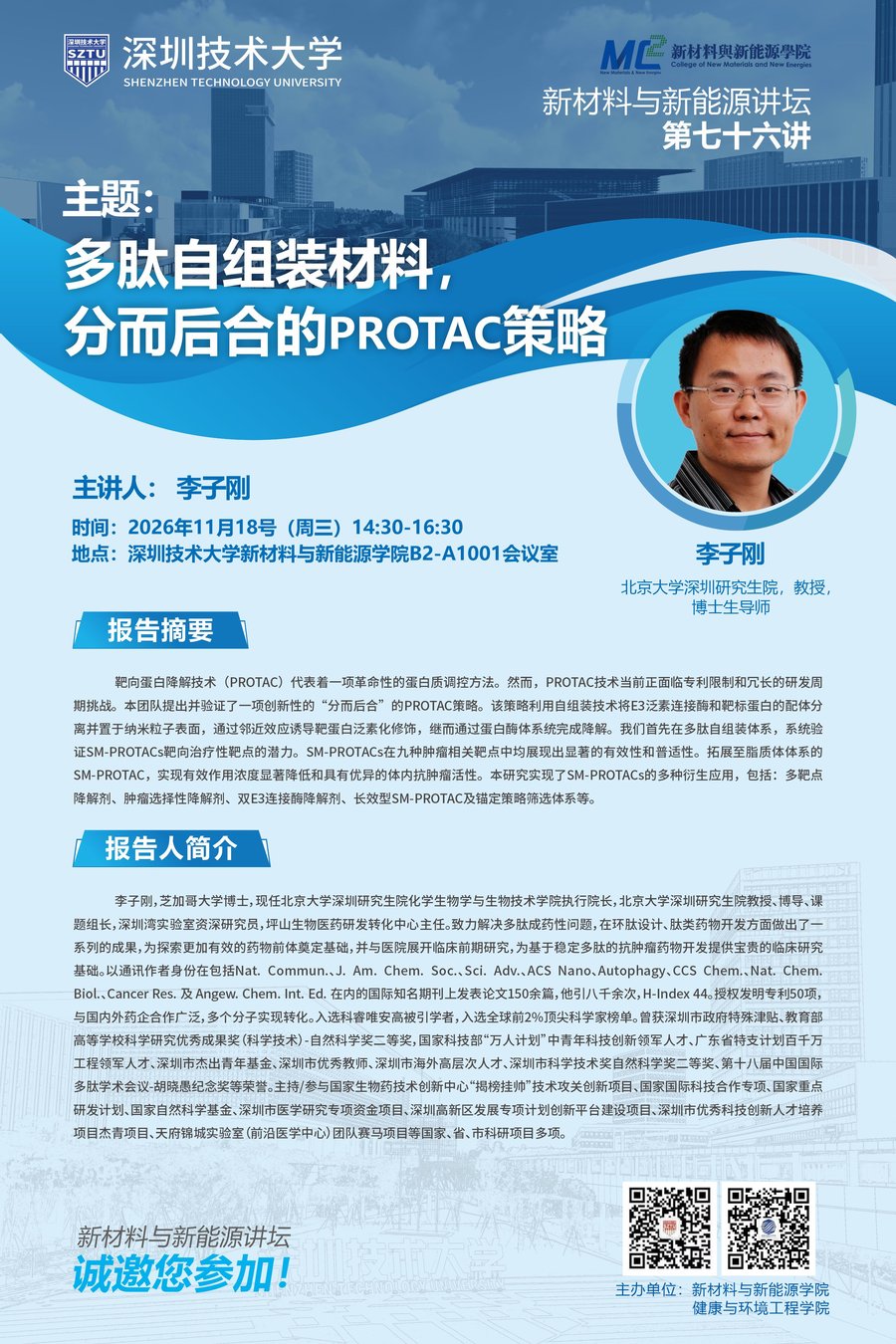
Topic: Peptide Self-Assembly Materials — A “Divide-and-Recombine” PROTAC Strategy
Speaker: Prof. Li Zigang (Peking University Shenzhen Graduate School)
Time: 14:30–16:30, Wednesday, November 18, 2026
Venue: Conference Room B2-A1001, School of New Materials and New Energy, Shenzhen Technology University
Abstract: Targeted protein degradation (PROTAC) represents a revolutionary approach to protein regulation. However, PROTAC technology currently faces patent restrictions and lengthy R&D cycles. The team proposed and validated an innovative “divide-and-recombine” PROTAC strategy: using self-assembly technology, the E3 ubiquitin ligase-recruiting moiety and the target-protein ligand are separated and displayed on the surface of nanoparticles, which induces targeted protein ubiquitination through a proximity effect, followed by degradation via the proteasome system. In a multi-peptide self-assembly system, the team systematically validated the potential of SM-PROTACs against therapeutic targets; SM-PROTACs showed significant efficacy and broad applicability across nine tumor-related targets. Extended to liposome systems, SM-PROTAC achieved significantly reduced effective concentrations and excellent in vivo antitumor activity. This work enables multiple derivative applications of SM-PROTACs, including multi-target degraders, tumor-selective degraders, dual-E3-linker degraders, long-acting SM-PROTACs, and anchor-strategy screening systems.
About the Speaker: Li Zigang received his PhD from the University of Chicago. He is Executive Dean of the School of Chemical Biology and Biotechnology at Peking University Shenzhen Graduate School, where he also serves as professor, doctoral supervisor and course-group leader; he is a senior researcher at Shenzhen Bay Laboratory and director of the Pingshan Biomedical R&D and Translation Center. Focusing on druggability of peptides, he has made a series of achievements in cyclic-peptide design and peptide-drug development, laying a foundation for more effective prodrug strategies and providing a clinical research basis for antitumor peptide drugs. He has published more than 150 papers in internationally renowned journals such as Nature Communications, J. Am. Chem. Soc., Sci. Adv., ACS Nano, CCS Chem., Nat. Chem. Biol., Cancer Res. and Angew. Chem. Int. Ed., with over 8,000 citations and an H-index of 44; he holds more than 50 authorized invention patents, and several molecules have been translated in cooperation with pharmaceutical companies at home and abroad. He has been selected as a Clarivate Highly Cited Researcher and into the global top 2% scientists list, and has received numerous honors including the Shenzhen Municipal Government Special Allowance and the Second Prize of the Shenzhen Science and Technology Award for Natural Science. He has led or participated in many national, provincial and municipal research projects.
Source: https://nmne.sztu.edu.cn/info/1151/4841.htm






 Address: No. 3002, Lantian Road, Pingshan District, Shenzhen, Guangdong Province zip code: 518118
 Tel: 0755-23256080


