Recently, the research team led by Professor Su Yaorong from our college published a latest research paper titled
Enhancing photocatalytic H₂ evolution by weakening S-Hₐd bonds via Co-induced asymmetric electron distribution in NiCoS cocatalysts in the internationally renowned academic journal
Chinese Journal of Catalysis (CAS Zone 1, Impact Factor: 17.7). The School of New Materials and New Energy is the sole corresponding institution. Assistant Professor Zhong Wei, Associate Professor Meng Aiyun, and Cai Xudong, an undergraduate student of the 2021 Materials Science and Engineering program, are co-first authors, while Professor Su Yaorong is the corresponding author.
Solar-driven semiconductor photocatalytic hydrogen production technology directly converts solar energy into hydrogen energy and is regarded as one of the most promising approaches for hydrogen production. Developing efficient and low-cost photocatalytic hydrogen evolution cocatalysts can significantly enhance photocatalytic hydrogen production activity, further promoting the practical application of this technology. Transition metal sulfide cocatalysts feature abundant raw materials, stable properties, and excellent catalytic activity, making them highly valuable for photocatalytic hydrogen evolution. However, in traditional transition metal sulfide cocatalysts (e.g., NiS), overly strong S-Hₐd bonds between sulfur (S) active sites and hydrogen evolution intermediates (Hₐd) severely hinder hydrogen molecule desorption, resulting in low hydrogen evolution efficiency. Therefore, regulating the electronic structure of S atoms to optimize interfacial reactions is a key research direction to break through this performance bottleneck.
This study proposes breaking the symmetric electronic structure of NiS via Co doping to construct homogeneous NiCoS cocatalysts with asymmetric electron distribution. This strategy successfully optimizes the electronic configuration of S sites and effectively modulates the strength of S-Hₐd bonds, offering a new approach for designing non-noble metal cocatalysts. In this work, homogeneous amorphous NiCoS nanoparticles were first modified on TiO₂ surfaces via a one-step photodeposition method. Theoretical calculations and XPS results reveal that Co introduction induces charge density redistribution in the NiS structure, forming an asymmetric electron distribution state. Electrons transfer from Co to S atoms, generating electron-rich S^(2+δ)-active sites. When electron-rich S^(2+δ)-active sites interact with hydrogen evolution intermediate Hₐd, increased antibonding orbital occupancy effectively weakens S-Hₐd bonds, bringing the Gibbs free energy of hydrogen adsorption (ΔG_H*) closer to zero. This endows NiCoS cocatalysts with higher interfacial catalytic hydrogen evolution efficiency. When the Co-to-Ni atomic ratio is 2:1, the photocatalytic hydrogen production rate of the NiCoS/TiO₂(1:2) sample is 2.1 times that of the NiS/TiO₂ sample. Meanwhile, the NiCoS/TiO₂(1:2) photocatalyst exhibits excellent photocatalytic cycling stability.
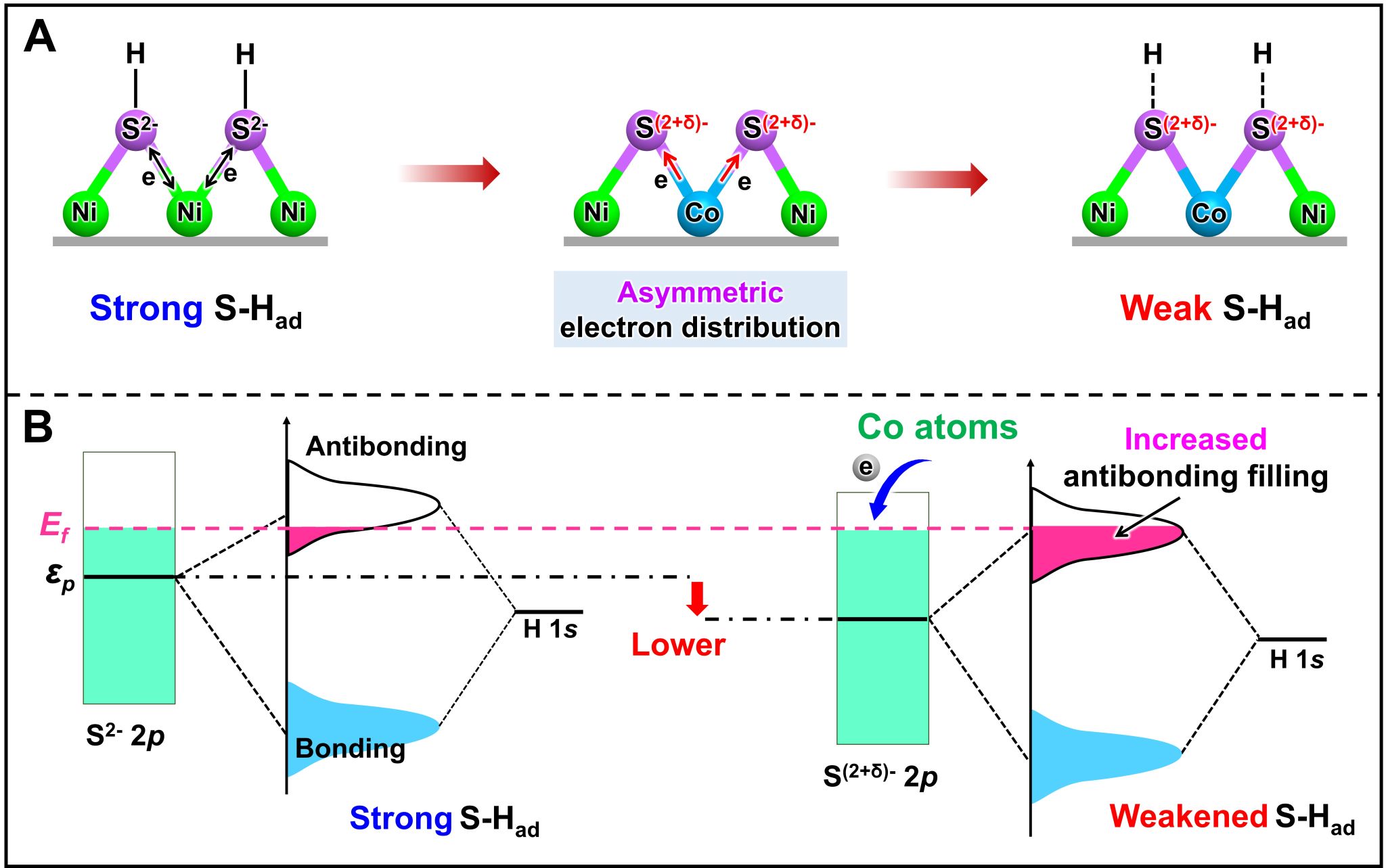
Figure 1. Mechanism of Co-induced asymmetric charge distribution enhancing the photocatalytic hydrogen production efficiency of NiCoS cocatalysts
This study reveals the catalytic mechanism of "asymmetric electron distribution → electron-rich S sites → antibonding orbital occupancy → S-Hₐd bond strength → interfacial catalytic hydrogen evolution reaction", providing critical technical references and theoretical support for constructing high-efficiency photocatalytic materials for solar-to-hydrogen conversion technology.
This work was supported by the National Natural Science Foundation of China, the Guangdong Basic and Applied Basic Research Foundation, the Shenzhen Science and Technology Innovation Commission, the Shenzhen Key Laboratory of Superhard Diamond and Functional Crystal Application Technology, and the Hubei Key Laboratory of Pollutant Analysis and Resource Recycling Technology.






 Address: No. 3002, Lantian Road, Pingshan District, Shenzhen, Guangdong Province zip code: 518118
 Tel: 0755-23256080


